The reading room · Tarot
How many cards for this question?
One card keeps the focus narrow. Three trace a sequence. Ten make room for the background, other people and competing concerns. More cards do not guarantee a more accurate answer.
01 / One card
One card: stay with one question
A one-card reading works well for a small, specific question. Choose one thing you want to think about instead of asking about your whole future.
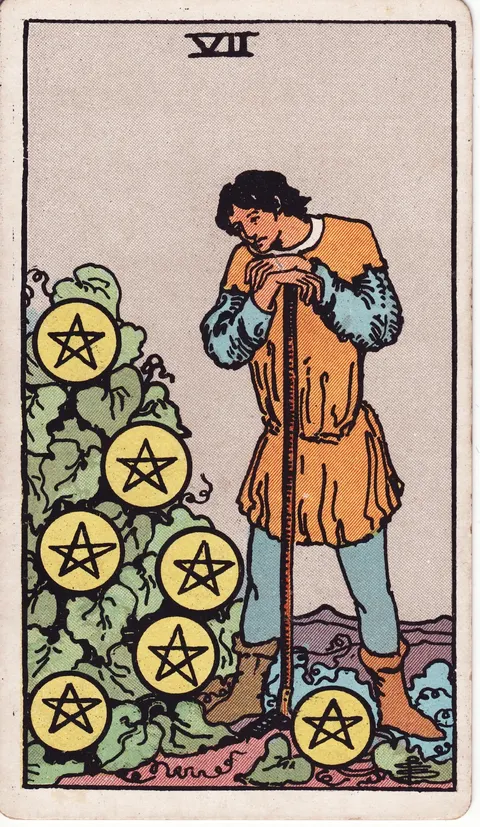
What should I pay attention to while putting my portfolio together today?
Start with the picture
The figure has paused to look at what has grown. Before calling this a success or a failure, notice the moment of taking stock of the work already done.
Bring it back to your question
For a portfolio, ask which pieces are ready and which you keep revising. The card can prompt you to review what you have; it cannot promise that someone will accept your work.
Write down one useful next step
Today I will choose my three most finished pieces and note which descriptions still need work.
When is one card enough?
What if the card does not resonate?
Check whether your question is too broad, or write down what you do not understand yet. You do not need to keep drawing until you get an answer you like.
Can a single card be reversed?
Yes. Read its orientation alongside the picture and your question, rather than treating a reversed card as automatically bad.
When should I use more cards?
Try three to explore a sequence. Use the Celtic Cross when separating your goal, challenges and surroundings would help you think through the situation.
03 / Three cards
Past, present, future
A three-card spread gives you a sequence to follow: past, present and future. Decide what each position means before turning the cards over.
Past, present and future
Meet G’s three-card spread uses past, present and future, from left to right. This familiar sequence also appears in Labyrinthos’s guide to three-card layouts.
Keep those positions in mind as you turn over the cards. If your question concerns the coming month, write that timeframe down too; a future position does not come with a built-in date.
Here is a deliberately chosen teaching example, with all three cards upright. The question is: “What should I pay attention to as I prepare my first exhibition?”
The figure pauses beside what has grown: a moment to review the work already put in.
Which pieces are finished, and which have stayed half-done?
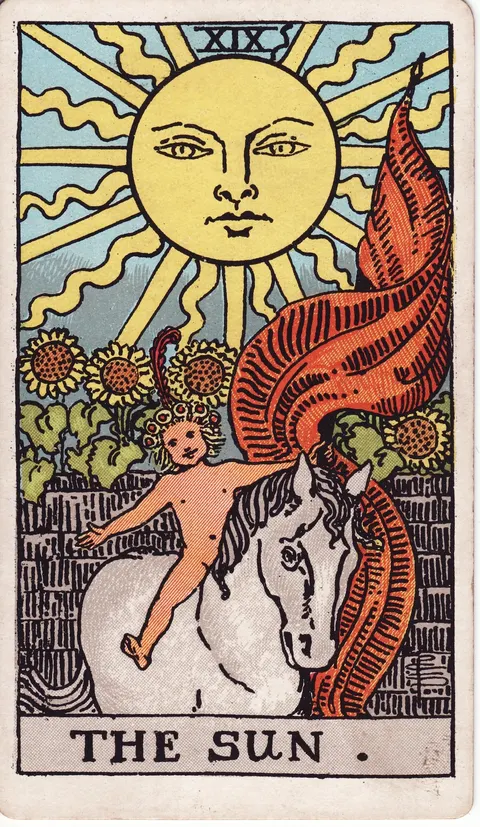
In the present, the Sun can suggest bringing your work into view and hearing a response.
Which pieces could you show someone now?
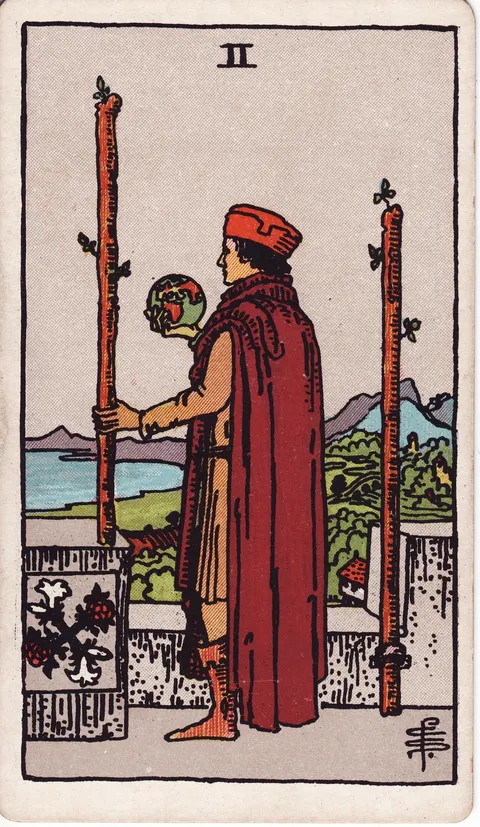
The figure looks outward with a globe in hand, inviting a wider view of the next step.
Would you try a small exhibition or an online portfolio next?
The future position explores where the story might lead from here. Keep that reading open as your choices and circumstances develop.
Read the position as well as the card
Read together, the three cards could become a note like this:
I have prepared a body of work; I can share a small selection for feedback, then decide how to show it next.
If the Sun appeared in the past position, the question would change. The Sun card guide gives examples of how position and orientation shape a reading.
Keep the reading small enough to use
Finish with one thing you want to think through or try. If the interpretations conflict, note the tension instead of forcing a neat story.
Keep the question and positions in mind as you read. After a few days, consider what happened and whether your first interpretation still fits.
Tarot in Meet G offers one card, a past–present–future spread and a ten-card Celtic Cross. You can explore the interpretation and talk it through with G, all within the same app.
For more examples, see how to ask a tarot question.
For a wider view of one situation, explore the Celtic cross positions. If a card is upside down, the reversal guide shows how context changes the reading.
A few common questions
Does the future position mean next week?
It has no fixed deadline. Set the time frame in your question before drawing, and treat that position as a possible development within the reading.
How do I connect cards that seem to disagree?
Keep their roles separate first. A difficult past and a hopeful present can coexist. Describe what changed between the positions before trying to write one overall reading.
Would ten cards make the answer more accurate?
More positions give you more angles to consider, but do not guarantee accuracy. Choose the Celtic cross when the question needs that extra context, rather than to replace an answer you disliked.
10 / Celtic Cross
How to read the Celtic cross.
The Celtic cross uses ten cards to look at a situation from several angles: what is happening, what lies underneath it, your own response and what may follow. Read the positions first, then the relationships between them.
Explore the ten positions
This diagram follows the positions used in Meet G. Other books and decks may number the cross differently; keep one set of positions throughout a reading.
Choose a numbered card to read its role.
01 Present
The situation you are looking at now. Start here before interpreting what may come next.
What is happening, rather than what do I wish were happening?
02 Challenge
Something the situation asks you to work with: a difficulty, tension or competing demand.
What makes the next step difficult?
03 Foundation
The circumstances, habits or experience underneath the current situation.
What has this situation grown out of?
04 Past
An earlier influence that still helps explain the present.
Which earlier decision or experience still matters here?
05 Goal
What you are consciously trying to achieve. A goal is different from a promised result.
What would I like this experience to make possible?
06 Near future
A possible next development within the scope of the question. It has no automatic deadline.
What next step fits the situation in front of me?
07 Self
Your stance, response or way of taking part in the situation.
How am I approaching this?
08 Environment
People, resources and circumstances around you.
What help or constraint exists outside my own approach?
09 Hopes & fears
An expectation you are drawn to, or a worry shaping how you respond. Sometimes they share a theme.
What am I hoping for, and what am I afraid that would require?
10 Possible outcome
One way the whole situation could develop, read alongside the other nine cards.
If I continue this way, what might I need to adjust?
A worked example: sharing your work for the first time
These ten cards were chosen for a teaching example, not drawn for you. The question is: “What should I consider as I prepare my first small exhibition?” All are upright except the Two of Wands and Six of Wands.
- Present · The Sun · upright
There is work ready to be seen. The immediate focus is sharing it clearly.
- Challenge · Two of Wands · reversed
You keep comparing venues without contacting any of them. Choosing has started to replace doing.
- Foundation · Eight of Pentacles · upright
Regular practice has given you a body of work. That preparation is something you can draw on.
- Past · Seven of Pentacles · upright
You have spent time making and reviewing pieces, and now want to see what that effort can become.
- Goal · Three of Pentacles · upright
You want useful conversations about your craft, not just a room full of visitors.
- Near future · Page of Wands · upright
An introductory message or small proposal gives the idea somewhere to begin.
- Self · The Hermit · upright
Working alone has helped you concentrate. Consider when to invite another person into the process.
- Environment · Six of Pentacles · upright
A friend might offer practical help. Ask what is available and agree what each person will do.
- Hopes & fears · Six of Wands · reversed
Wanting recognition sits beside a fear of being overlooked. Neither tells you how visitors will actually respond.
- Possible outcome · Temperance · upright
A manageable pace and realistic scope give the project room to develop without taking over everything else.
The work is already taking shape, but choosing a format has become a sticking point. A small proposal and a conversation with someone who can help may be more useful than waiting for universal approval. Give the preparation a pace you can sustain.
When are ten cards useful?
A question with several moving parts can benefit from a wider spread. “What should I consider as I prepare an exhibition?” leaves room to examine your aims, the preparation and the people involved. For one small decision, a single card or three-card spread may be easier to work with.
Choose the question and its scope before drawing. These examples of tarot questions can help you narrow it down.
Read pairs before the whole spread
- 1 + 2 · Situation and challenge
- What is happening, and what makes it difficult? Keep the two roles distinct even when the cards share a theme.
- 3 + 5 · Foundation and goal
- How does what you want compare with what the situation currently rests on?
- 7 + 8 · Self and environment
- Separate your approach from other people’s choices and the resources around you.
- 6 + 10 · Next step and possible outcome
- Look at an immediate development alongside the wider direction. Neither position sets a fixed date.
Return to the original question and write a few connected sentences. If two cards seem to disagree, leave that tension visible. “I want to share this, but keep postponing the invitation” is more useful than forcing every card into a cheerful story.
Questions about this spread
Does the sideways second card mean reversed?
Its sideways placement marks the challenge position. Placement and reversal are separate: in Meet G, read the card’s upright or reversed label. The diagram’s horizontal rectangle does not itself mean reversed.
Is the tenth card a definite result?
It is the possible outcome within this reading. Read it with the earlier cards and the choices still open to you. It does not establish what another person will do.
Must every Celtic cross use this numbering?
No. You may find different arrangements for the central six cards. This page follows Meet G; when using a book or another deck, check its position key first.
Meet G’s tarot feature includes the Celtic cross alongside single-card and three-card readings. For a closer look at card orientation, continue with reading reversed cards.
Want to try it in the app?
Explore tarot in Meet GQuestions for tarot
Find tarot question examples for work, relationships and choices, with reasons for each rewrite and a worked reading example.
TarotReading reversed cards
Learn what a reversed tarot card means, compare two readings of the Sun, and see how the question and position shape an interpretation.
Inside Meet GTarot readings
Bring a question, choose a tarot spread, draw your cards and explore the reading with G. Revisit past readings and keep a note of your own response.