The reading room · Tarot
Reading reversed tarot cards.
A reversed tarot card appears upside down relative to the reader. It adds another way to consider the card’s theme, but it does not automatically turn the reading into bad news. Start with the question, the position and the card itself.
Begin with the card’s theme
With the Sun, you might begin with openness, clarity and enjoyment. Reversed, that theme can lead you to ask whether enjoyment feels muted or expectations have become difficult to meet. That is a more specific starting point than “everything will go wrong”.
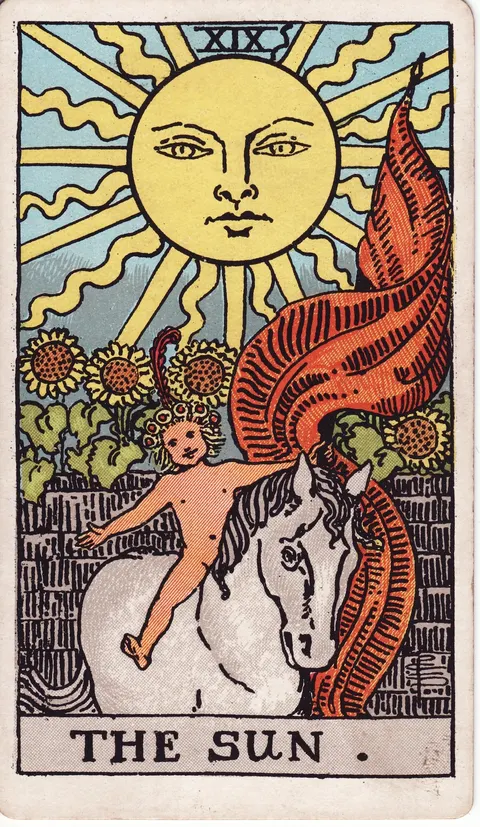
These are starting questions, not definitions to apply to every situation. The Sun card guide explores its imagery and several reading contexts.
The same reversed card, two different positions
Imagine you are preparing a small exhibition and have chosen the Sun reversed for a teaching example.
- In the present
- Perhaps you are so focused on what is unfinished that you cannot enjoy the work already ready to share. Check that thought against what is actually happening.
- In hopes & fears
- The focus shifts to expectations: do you hope everyone will love the work, while fearing that an ordinary response means failure?
The card has not changed, but the position changes the question you ask of it. Neither example tells you in advance what visitors will think.
Use a few possibilities, then check them
A reversal might suggest a theme that is difficult to express, a tendency taken too far, or something that is beginning to loosen. These are possible approaches, not a rule that every reversed card must follow.
For instance, the Two of Wands reversed can prompt a look at reluctance to leave the familiar. In a practical question, ask what information or preparation is missing before deciding that hesitation is the whole story.
If an interpretation does not fit the question or the other cards, leave it open. You do not have to manufacture a problem to make a reversal feel meaningful.
Questions about reversals
Do I have to use reversed cards?
No. Readers use different approaches. Decide before drawing whether you will read reversals, then keep that choice consistent through the reading.
Are several reversed cards a bad sign?
The count alone cannot establish an outcome. Look at which positions they occupy and whether their themes actually connect to the question.
Should I draw again if I dislike a reversed card?
First return to the original question and read what is already there. Repeating a draw until it feels reassuring can make it harder to tell what you were trying to understand.
Try these ideas with the three-card reading example, or explore how the positions differ in the Celtic cross. In Meet G’s tarot readings, each drawn card’s orientation is part of the reading.
The Sun tarot card
Explore the Sun’s upright and reversed meanings, with examples that connect the card to a question and its place in a spread.
TarotTarot spreads
Explore one-card, past–present–future and Celtic Cross tarot spreads. Switch between layouts, worked examples and reading tips to choose a spread for your question.